

Qubit was a South Korea-based DeFi lending protocol built on the BNB chain. Qubit also ran an associated protocol, the QBridge, that allows users to use assets on other chains as collateral to borrow against on Qubit, without actually moving those other assets onto BNB Chain. Users send assets they want to collateralize to a QBridge smart contract on those assets’ chains, and QBridge mints an equivalent asset on the BNB Chain.
Unfortunately, as has happened with many cross-chain bridges, hackers found an exploitable error in the code governing QBridge, and were able to drain the protocol of all of its holdings — roughly $80 million in assets, making it South Korea’s largest crypto theft of 2022. We can now share publicly for the first time our assessment that this hack was likely the work of North Korea-linked hackers, as was the case with so many other large DeFi hacks in 2022. Let’s take a look at how the Qubit hack unfolded.
How Qubit was hacked
The exploit the Qubit hackers discovered allowed them to mint unlimited qXETH — an asset meant to represent Ether bridged from the Ethereum blockchain — from the QBridge, without actually depositing any Ether. The hackers used the unbacked qXETH as collateral to “borrow” all of the assets held by the protocol — mostly BNB coin but also several BEP-20 tokens — worth roughly $80 million at the time of the theft. The hackers then bridged those funds to the Ethereum blockchain.
Once they bridged the funds from BNB Chain to Ethereum, the hackers used what was at the time North Korean crypto criminals’ go-to money laundering strategy: They sent the funds to the crypto mixer Tornado Cash. We can see an example of some of that activity following the Qubit hack below:
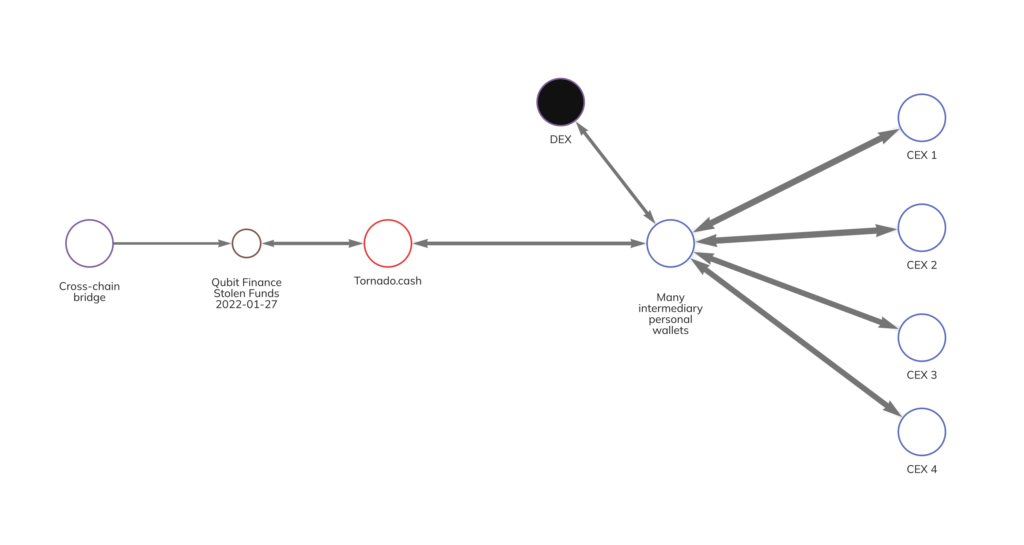
The hackers received their newly mixed Ether from Tornado Cash, and from there sent a portion to a decentralized exchange to be swapped for different ERC-20 tokens, while the rest was moved to deposit addresses at various centralized crypto exchanges. The Qubit hack exemplifies many of the key elements of the North Korean hacking strategy we saw in 2022: Exploit a DeFi protocol, bridge the funds to a blockchain where funds can’t be frozen, mix them, and move them to a centralized exchange. In this case, South Korea’s Transnational Crime Information Center (TCIC) and NIS (National Intelligence Service) were able to trace the funds in partnership with Chainalysis following the theft.
Fighting the North Korean crypto hacking threat
北朝鮮と関連するハッカーたちは間違いなく高度な手口を用い、仮想通貨エコシステムにとって重大な脅威となっているが、法執行機関 国家安全保障機関の対抗能力も高まりつつある。例えば昨年、北朝鮮と関連するハッカーによって盗まれた資金が史上初めて差し押さえられた事例があり、捜査官たちは 3,000万ドル相当の 相当の暗号資産を回収した。今後数年間で、こうした事例がさらに増えるものと予想されるハッキングその主なハッキング、ブロックチェーンの透明性にある。すべての取引が公開台帳に記録されるということは、事件発生から数年が経過した後であっても、法執行機関 追跡できる手がかりが残されていることを意味し、捜査技術が時とともに向上する中で、これは極めて貴重なものである。 法執行機関の能力向上に加え、OFAC (米国OFAC などの機関が、ハッカーが好んで利用するマネーロンダリングサービスを暗号資産 から遮断OFAC 取り組みも相まって、こうしたハッキングは年を追うごとに困難になり、得られる利益も減少していくことになるでしょう。
本資料は情報提供のみを目的としており、法律、税務、財務、または投資に関する助言を提供するものではありません。受領者は、こうした決定を行う前に、各自のアドバイザーに相談してください。Chainalysis は、受領者が本資料を利用したことに起因する、つながり におけるいかなる決定、その他の作為または不作為についても、一切の責任を負いません。
Chainalysis 当社は、本報告書に記載された情報の正確性、完全性、適時性、適合性、または有効性を保証するものではなく、当該資料のいかなる部分における誤り、欠落、またはその他の不正確さに起因するいかなる請求についても責任を負いません。


