
Central & Southern Asia and Oceania (CSAO) is the third largest cryptocurrency market in our index this year, with citizens of CSAO countries receiving $932 billion in cryptocurrency value from July 2021 to June 2022. CSAO is also home to seven of the top twenty countries in this year’s index: Vietnam (1), the Philippines (2), India (4), Pakistan (6), Thailand (8), Nepal (16), and Indonesia (20).
Later in this section, we will analyze the main drivers of – and barriers to – grassroots cryptocurrency adoption in these countries. But first, let’s look at CSAO in aggregate.
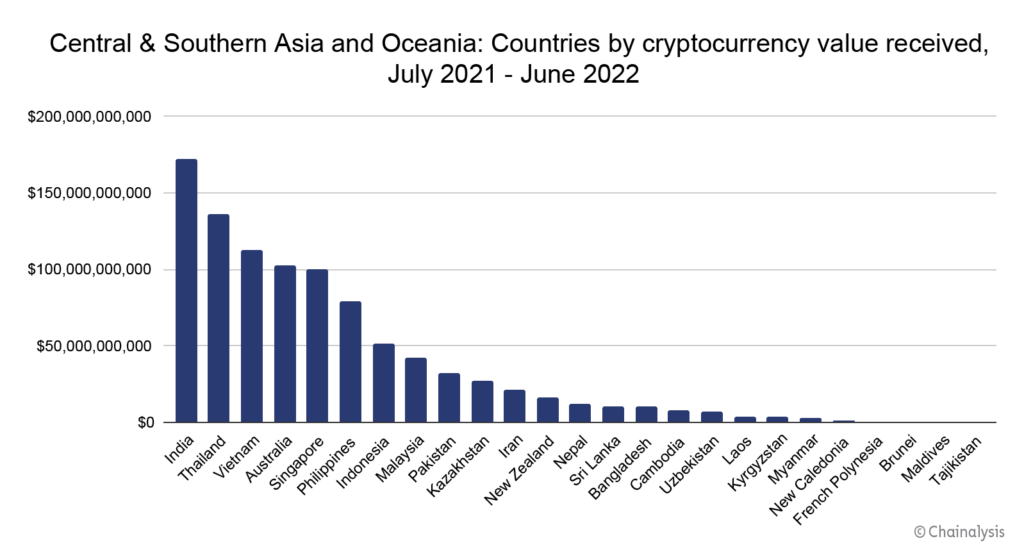
India continues to lead CSAO in unweighted crypto activity, receiving $172 billion in cryptocurrency value from July 2021 through June of this year. Thailand, Vietnam, Australia and Singapore follow close behind with each receiving more than $100 billion. Less engaged with cryptocurrencies, however, are Central Asian countries like Uzbekistan and Oceanian island nations like the Maldives.
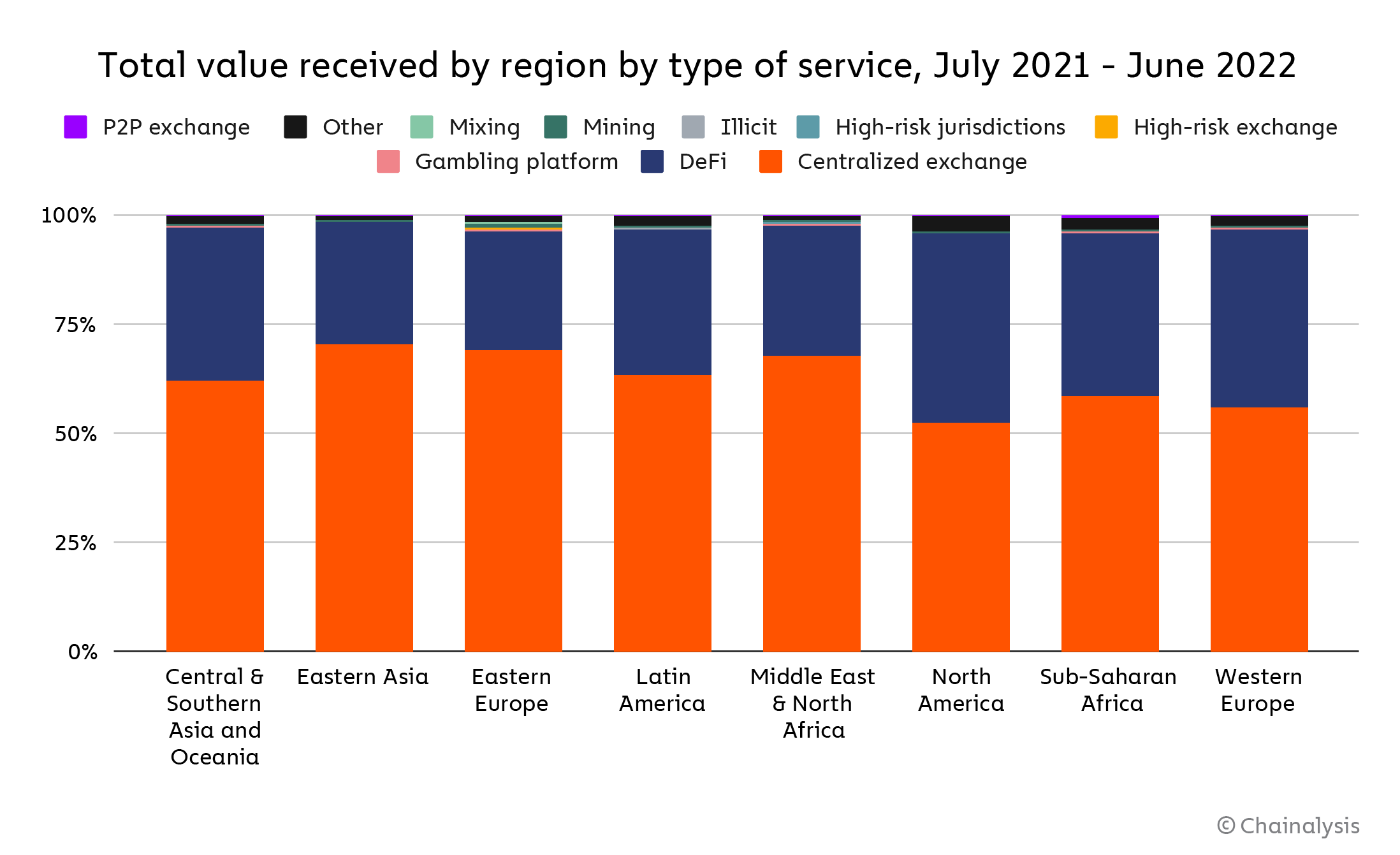
Like other regions, CSAO sees the majority of its crypto activity happen on centralized services. Based on transaction volume, the region is in the middle of the pack when it comes to DeFi adoption. But the data gets more interesting when we dig into what’s driving that DeFi adoption.
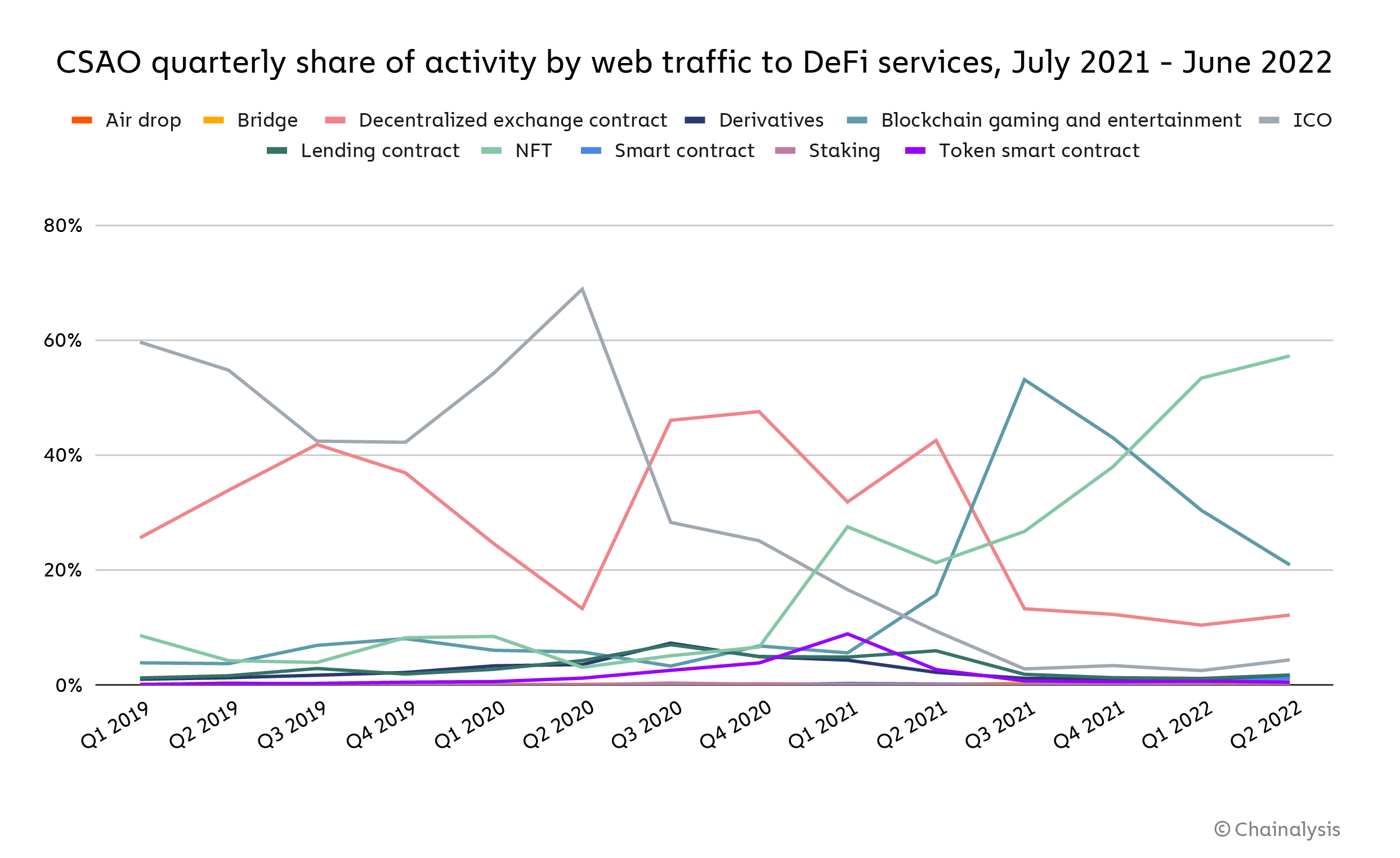
For instance, web traffic patterns suggest NFTs are perhaps the biggest on-ramp into DeFi for CSAO today. 58% of DeFi-related web traffic from CSAO users in Q2 2022 was NFT related; another 21% was to the websites of play-to-earn blockchain games.
Play-to-earn games and non-fungible tokens are intimately related. In most blockchain games today, the in-game items are NFTs, like Axie pets in Axie Infinity and Sneakers in STEPN, which can be resold on a number of different NFT marketplaces, like MagicEden and OpenSea. For countries with high web traffic to NFT marketplaces – especially Thailand, Vietnam, and the Philippines – a large portion of that NFT-related traffic may therefore come from players of blockchain games.
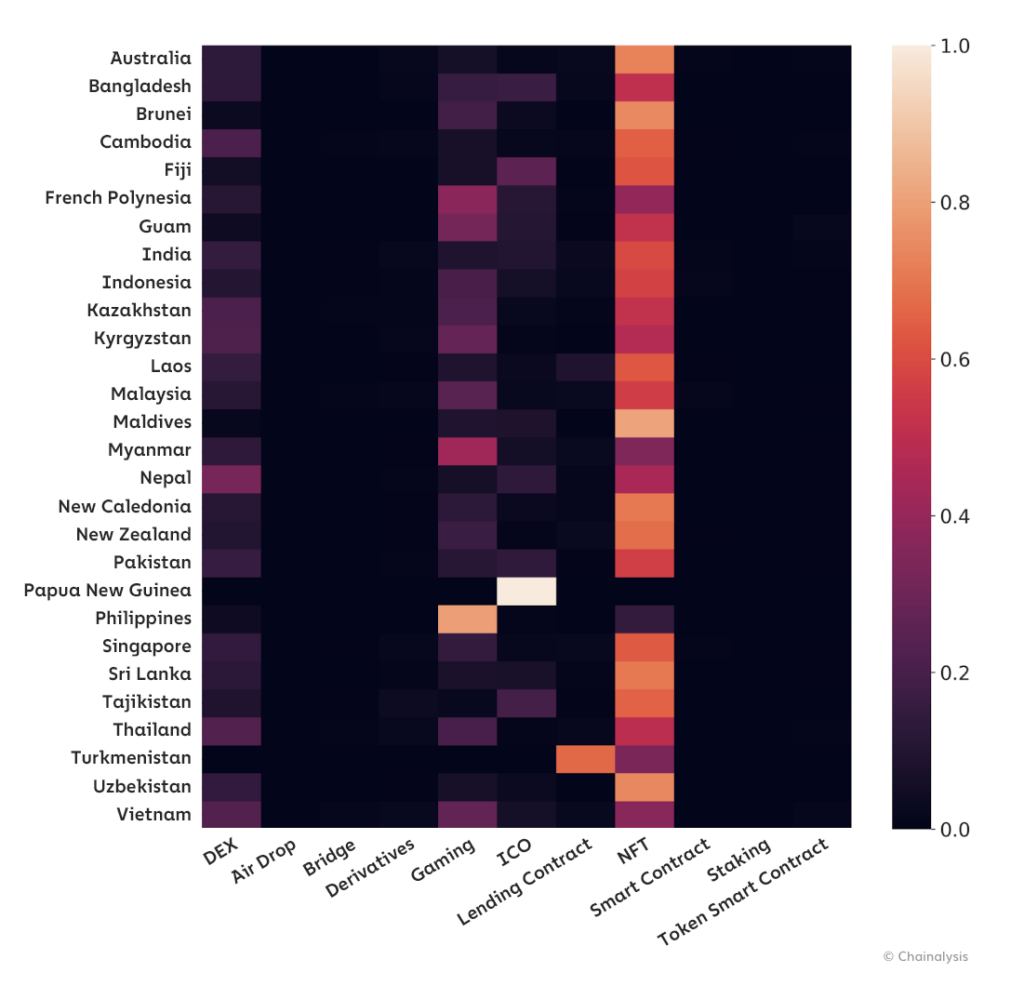
As the above heatmap shows, NFT-related websites account for a majority share of DeFi-related web traffic in almost every CSAO country — but most of these same countries have their second-highest share going to blockchain games and entertainment.
This is not necessarily surprising: CSAO is a hub for innovation in blockchain-based entertainment. Game-centric blockchain developers Polygon and Immutable X are headquartered in India and Australia, for example, and Axie Infinity and STEPN, the two largest play-to-earn games, are operated in Vietnam and Australia, respectively.
Traffic to websites related to subjects like decentralized exchange contracts, however, has declined in recent quarters. This is likely connected to the bear market overall. Manan Vora, Senior Vice President of Operations and Strategy at Liminal, a Singapore-based wallet infrastructure provider, found this to be the case. “The UST crash played a big role in shaking the confidence of the crypto market. When a top ten coin goes to zero, it becomes very difficult to get people who have just entered the market to stay in the market. These are the users that you may lose forever.”
Now that we’ve looked at CSAO’s crypto markets at large, let’s zoom in on the most active countries within the region.
Play-to-earn games and remittance payments drive rapid adoption in Vietnam and the Philippines
For the second consecutive year, Vietnam ranked the highest in our cryptocurrency adoption index. The Philippines, meanwhile, made a giant leap, jumping from 15th to second. Both of these countries have similar growth drivers: play-to-earn (P2E) games and remittances.
The first of these, P2E games, we’ve already addressed in part above — but it’s worth noting the sheer scale of P2E penetration in these two countries in particular. An estimated 25% of Filipinos and 23% of Vietnamese citizens have played a play-to-earn game, and at one point, players based in the Philippines made up 40% of Axie Infinity’s playerbase. Meanwhile, Axie Infinity’s developer, Sky Mavis, is based in Vietnam.
Vietnam and the Philippines are also massive remittance markets, with remittance inflows accounting for 5% and 9.6% of their respective country-wide gross domestic products. In Manan Vora’s view, cryptocurrencies – especially stablecoins – help bridge the gap in cases where parents don’t have access to traditional banking channels and money transfer services like Western Union charge high fees. “It makes a lot of sense. Why pay 3% to a banking intermediary and wait two days for the funds to reach them when USDT/USDC can reach them within one minute, with almost zero fees?”
The same remittance thesis resonates for other CSAO countries as well. Pakistan, India, and Bangladesh each have $20+ billion remittance markets, and blockchain-based payment providers are beginning to disrupt traditional intermediaries. Some of these payment rails are even being built in coordination with government agencies, such as the Pakistani central bank’s work with Alipay. These transfers are generally made via stablecoins, so that the value being transferred is preserved in transit.
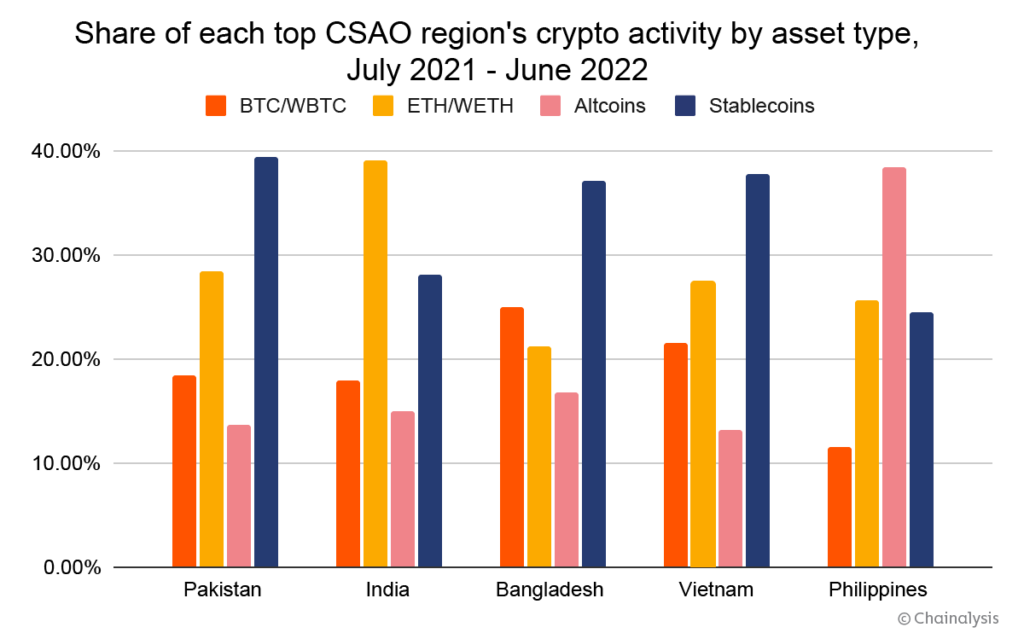
As the graph above shows, stablecoins and ETH/WETH are the top two most actively traded asset types in many CSAO countries – consistent with a remittance and NFT-centric adoption model.
Indian and Pakistani crypto regulations likely dampen activity, but not the pace of innovation
In our 2021 crypto adoption index, we found that Indian and Pakistani citizens were the second and third highest adopters of cryptocurrency globally, respectively. In 2022, they’ve fallen to fourth and sixth. Recent regulatory developments may help explain why.
インド
On April 1st, 2022, the Indian government implemented a 30% tax on all crypto gains, with no ability for users to offset their losses. Then, on July 1st, the government also implemented a 1% transaction deduction at source (TDS), meaning that crypto users must pay an additional 1% fee on every transaction. “This led to a lot of brain drain,” said Vora: “first to Singapore, and now to Dubai. … because even if your business is market-making, it is now effectively being treated as a lottery business.”
Vikram Rangala, the Director of ZebPay, an Indian crypto exchange, helped us understand the government’s perspective on these new rules. For them, he explained, it’s about consumer protection:
From the conversations I and my colleagues have had, people in the Indian government, including members of parliament, aren’t anti-crypto per se. Some are very pro-crypto. But they’re worried about their constituents trading a volatile asset without adequate information. A 25-year-old saving to get married or provide for his family might trade some meme coin and get wiped out. No public servant can be seen backing something that’s so risky for most people. Rich people can survive such losses, but a house cleaner, farmer, or rickshaw driver cannot.
And in Rangala’s view, crypto innovation in India has continued unabated.
India has dozens of [crypto] projects working on establishing property rights, accessing tickets and membership passes, helping rural artisans monetize, even giving token holders the chance “to go skydiving with a movie star in Dubai,” and more.
パキスタン
In January this year, Pakistan’s central bank and government recommended a ban against cryptocurrencies. Since then, the federal government has formed three subcommittees to deliberate the matter further, and to eventually propose their own crypto policies. It remains to be seen whether or not the policies implemented will be as restrictive as the proposed ban.
Other issues further complicate Pakistani crypto adoption. The country has been on the Financial Action Task Force’s (FATF) gray list since 2018, hurting its ability to get international financial aid and hardening the government’s negative attitude towards cryptocurrencies. State Bank of Pakistan (SBP) Governor Reza Baqir stated in February that the potential risks associated with cryptocurrencies “far outweigh the benefits,” and named the “widening gray economy” and “capital flight” as key worries.
Given Pakistan’s current civil unrest – its former prime minister was recently charged under the country’s antiterrorism act yet remains one of Pakistan’s most popular leaders – Baqir’s concerns about crypto-based capital flight may prove prescient. Vikram Rangala suspects as much: “After watching Venezuela and Argentina, I think that anybody who’s in a country where things are not that stable, they’re starting to see cryptocurrency as a possibility.”
This blog is an excerpt from our 2022 Geography of Cryptocurrency Report. Sign up to download your copy today!
本ウェブサイトには、Chainalysis, Inc. およびその関連会社(以下、総称して「Chainalysis」)の管理下にない第三者のサイトへのリンクが含まれています。当該情報へのアクセスは、Chainalysis が当該サイトまたはその運営者との提携、支持、承認、または推奨を行っていることを意味するものではなく、Chainalysis は、当該サイトで提供される製品、サービス、その他のコンテンツについて一切の責任を負いません。
本資料は情報提供のみを目的としており、法律、税務、財務、または投資に関する助言を提供するものではありません。受領者は、こうした決定を行う前に、各自のアドバイザーに相談してください。Chainalysis は、受領者が本資料を利用したことに起因する、つながり におけるいかなる決定、その他の作為または不作為についても、一切の責任を負いません。
Chainalysis 当社は、本報告書に記載された情報の正確性、完全性、適時性、適合性、または有効性を保証するものではなく、当該資料のいかなる部分における誤り、欠落、またはその他の不正確さに起因するいかなる請求についても責任を負いません。


